
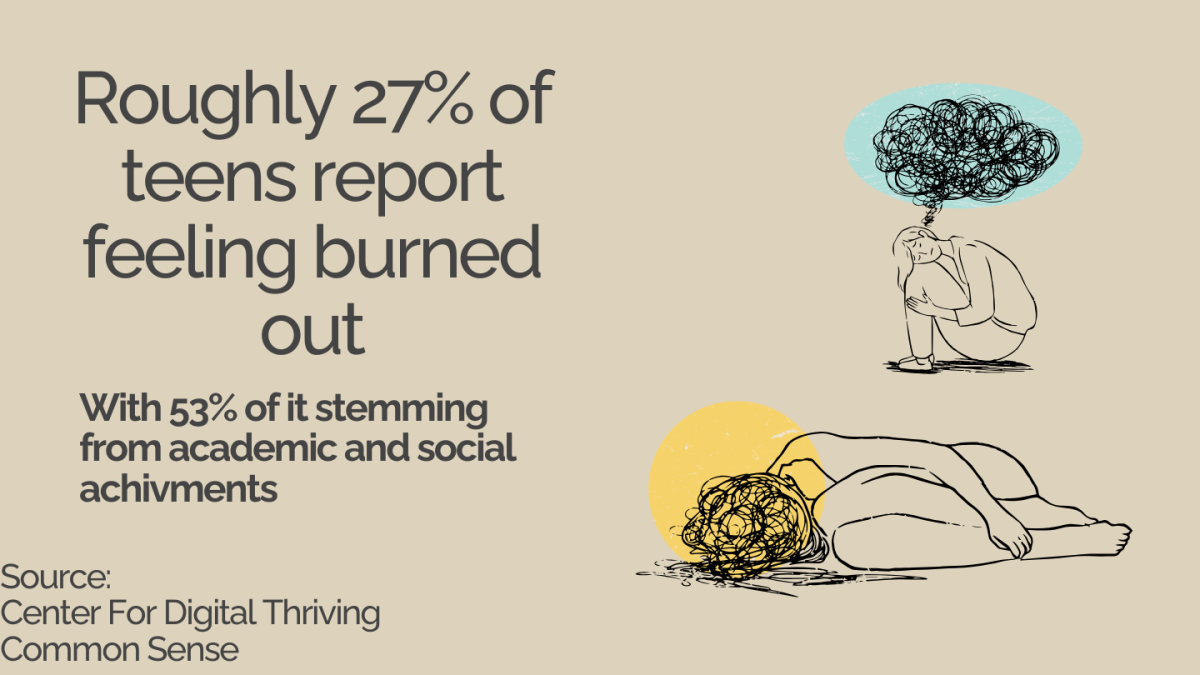
To get into a competitive, or even somewhat competitive, college while also being an appealing candidate, many students are looking at a minimum of five APs accompanied by a full course load. At most competitive schools, though, this is not enough to be an appealing candidate: many students need to add on extracurriculars to their already full course load.
This heavy workload is harming today’s high schoolers because by the time their work has paid off, they are too burnt out to continue their current habits; it does not help that most students also have more than college to think about: about 57% of high schoolers play sports and 22% have part time jobs.
Roughly 20-25% of high school students have part time jobs according to the U. S. Bureau Of Labor Statistics. This means that on top of students’ recommended course load of up to 12 APs, high schoolers may have to also work to either help support their family or pay for their own schooling. Because of this, it is sometimes non-negotiable for some students, meaning they must balance a minimum of 30 minutes of homework per class along with a full work schedule. For many teens, this is just the tip of the iceberg.
Many students also partake in sports, with as many as 57% of highschoolers playing athletics according to Education Week. A large amount of people rely on athletics to get into college for a more affordable option or to hopefully go pro. Most practices in California are between one and a half to three hours with CIF limiting it to a max of four hours a day and eighteen hours a week. Although this limits practicing time, it is still a large amount of time that is taken away from schoolwork.
While it is true that getting into a competitive school and participating in extracurriculars is not necessary, it is the goal and aspiration of many students, and the increase in competition for these colleges as well as a large grindset scene on social media making students push themselves to unhealthy levels.
The National Library of Medicine surveyed highschoolers with high and low course loads over four years. They found that students with higher course loads were prone to test taking anxiety as well as ineffective study strategies. This helps further show the point of how higher course loads are doing more damage than help to the people partaking.
In order to be an appealing candidate for competitive schools, students are looking at overflowing course loads that will drastically influence their lives and consume students. Students need to stop romanticizing burnout and show their peers what having a healthy relationship looks like.