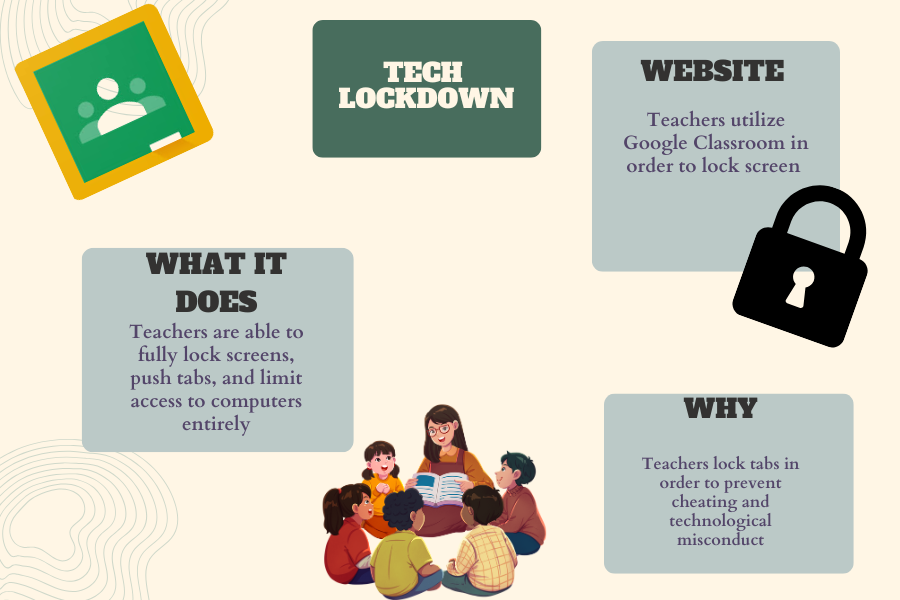
Humanity has advanced flawlessly, educating ourselves from the Osborne 1 in 1975, to 2025 with the Chromebooks. Likewise, technology has played a pivotal role in this enlightenment. However, this advancement raises concerns about privacy, especially in schools. New apps allow teachers to keep tabs on their students’ computer activity at any time.
Having a lack of screen privacy in school due to the use of Google classroom monitoring to look at students screens constantly. increases anxiety in highschool students as they feel like they cannot have any room to browse the internet themselves. Due to this suffocation, these ¨cyber shackles¨ cause a sense of moral injustice between students and teachers.
More importantly, among schools with this restriction of technological freedom, rebellion will ensue as the trust between teachers and students has collapsed. With a constant iron grip over the students, it is most natural for the students to act out against the screen monitoring.
Adding to this issue, cyberbullying becomes more of a prevalent problem as of 2022, half of US teens between the ages of 13 to 17 experience one of the six cyberbullying behaviors discussed. Cyberbullying is a result of the pent-up anger from the constant monitoring at school, causing students to lash out at other students.
Ultimately, constant surveillance is unsafe in any school setting. Relying on teachers’ feelings of online safety to rearrange priorities from school safety seems rather inappropriate, considering there are many more prevalent issues in today’s school systems. Whether it means tearing down the ¨technological prison¨ or building more, teachers need to reconsider their values.
Despite the idea that a lack of privacy creates an uncomfortable school environment, many continue to argue that online safety supersedes this idea of ¨privacy¨, and Some may even debate that privacy is irrelevant when it comes to using school-issued devices in a school environment.
On the contrary, even considering being in a school environment, these school devices are still personalized for student use. This is due to the rule that personal computers are not allowed when taking tests or completing certain assignments at CHS. Therefore, the issued computers should not be treated like an open territory, considering that many students use the same Chromebook for almost all 4 years. Having technology easily accessible bridges concerns with the structure of school itself. Without an alternative to the use of technology, students must have a choice not to be limited by the injustice of a stereotype that suggests all students are immature and will misuse their technology.
School is a place of safety, and the constant surveillance of devices by teachers is an invasion of privacy. For a productive future for both students and teachers, a ¨Big Brother¨ isn’t needed to maintain order.