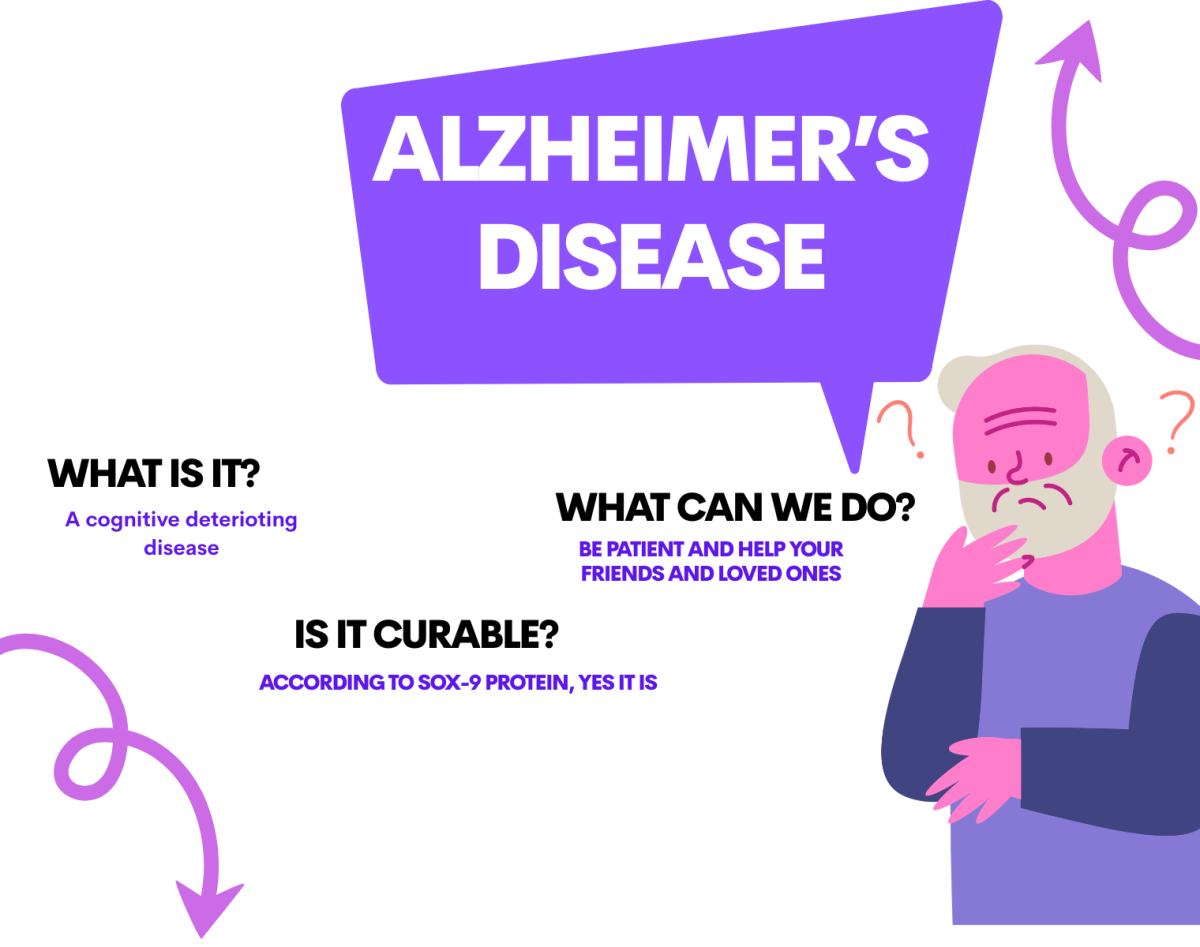
Memories are a foundational aspect of a cognitive life, and losing this ability can be devastating to both patients and families. Alzheimer’s is a disease that deteriorates the brain, and is especially common in older individuals. Recently, scientists have made a breakthrough in Alzheimer’s research through the discovery of the protein Sox-9, which could cure Alzheimer’s disease indefinitely.
While the physical impact of Alzheimer’s is only felt by a patient, families are also significantly impacted. Junior Gabriel Ayala has been a firsthand witness to a close family member deeply affected by Alzheimer’s.
“It’s hard to watch them slowly go from someone you knew to a complete stranger,” Ayala said. “I can’t imagine what it’s like.”
As the disease worsens, loved ones are forced to watch inhumane changes occur. Junior Sebastian Ochoa has also been in contact with a member of his family who suffers from Alzheimer’s.
“It really affects their memory, everyday it seems like they know less and less,” Ochoa said. “Once they started to forget our family everything went downhill.”
While the disease is widely known, many struggle to understand at what point the disease is in full force. The Sox-9 protein is still effective in its ability to revert Alzheimers, though to what extent is unknown.
“It doesn’t just take away the memories,” Ayala said. “It robs our family from ever experiencing authentic moments and the idea of never being able to experience true happiness [together], [which] is devastating.”
The Sox-9 protein is currently found in the cartilage, however the ethics of extraction are weighed as non living victims are the best candidates. The benefit of the extracted protein is the neurological improvement of the pathways that are affected in Alzheimer’s patients.
“I think it’s a great opportunity,” Ochoa said. “I think that I would give permission for extraction without a second guess
While scientists have now discovered the possibility of harvesting this protein, there are some constraints. The ethics of harvesting organic matter from people pose a valid debate.
“I think it’s a very important thing we should do,” Ayala said. “If this becomes one of the reasons Alzheimer’s can be cured then I am all in.”
Whether Sox-9 really will be able to cure Alzheimer’s is still being investigated by scientists, but for now it remains a beacon of hope for those whose loved ones suffer from the disease. As for CHS students, the protein is a reminder that even young adults can feel the impact of Alzheimer’s.
“Its not easy to deal with,” Ochoa said. “I feel very fortunate that these experiences will shape my view of the world.”